
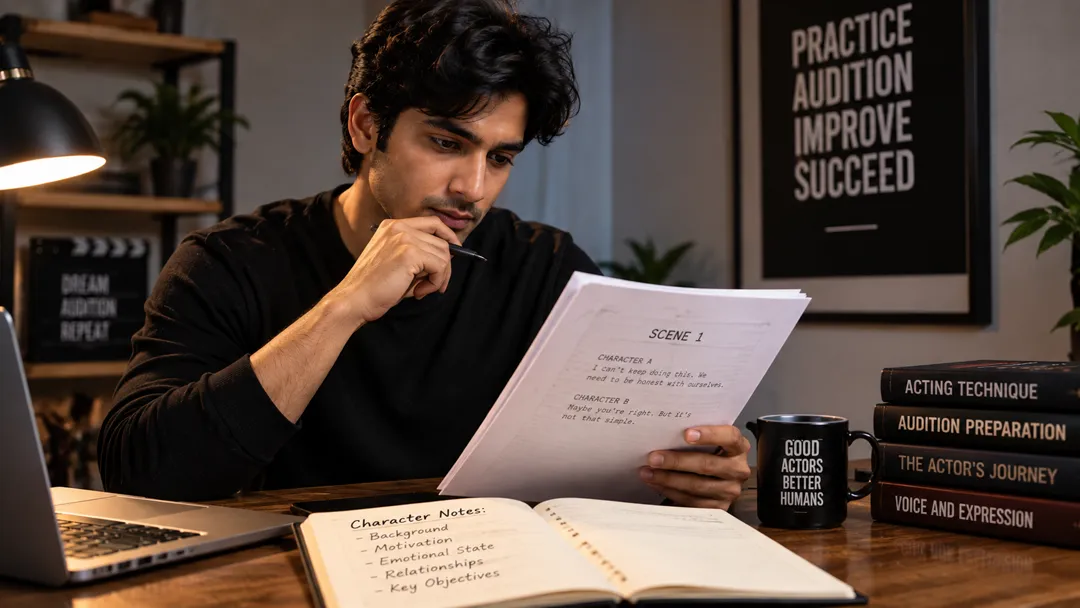
Acting Audition Tips: How to Prepare and Perform with Confidence
An acting audition is more than simply memorizing a few lines and performing them in front of a camera. It is an opportunity to show how you understand a character, respond to a situation, use your voice and expressions, and bring your own personality to a performance.
Whether you are preparing for your first audition or have already faced the camera several times, good preparation can help you perform with greater clarity and confidence.
Here are some practical acting audition tips that can help you prepare.
1. Understand the Scene Before Memorizing It
Before trying to remember every word, understand what is actually happening in the scene.
Ask yourself:
Who is my character?
What does the character want?
Who am I speaking to?
What happened immediately before this scene?
What emotion or situation is driving the conversation?
When you understand the intention behind the dialogue, your performance can feel more natural instead of sounding like memorized lines.
2. Know Your Lines, But Don't Sound Memorized
Knowing your dialogue gives you freedom during a performance.
However, there is a difference between remembering lines and simply reciting them.
Practice until you are comfortable enough with the dialogue that you can focus on the character, reactions, pauses and emotions rather than constantly thinking about the next sentence.
If you forget a word during an audition, avoid panicking. Stay connected to the scene and continue naturally whenever possible.
3. Make Clear Acting Choices
A casting team may see many people performing the same scene.
Your job is not necessarily to make the performance louder or more dramatic. Your job is to make clear choices about the character.
Think about:
the character's objective,
emotional state,
relationship with the other person,
pace of speaking,
and how the character reacts to what is happening.
A specific performance is usually more interesting than a vague one.
4. Keep Your Performance Natural
One common mistake during auditions is trying too hard to “show” every emotion.
Not every emotional moment requires a big expression or dramatic movement.
Sometimes a small pause, a change in your eyes, or a quieter delivery can communicate much more.
Focus on experiencing the situation rather than demonstrating the emotion.
5. Use Your Voice Clearly
Your performance can lose impact if your dialogue cannot be understood.
Before recording or performing:
warm up your voice,
speak clearly,
avoid rushing,
pronounce words naturally,
and make sure your volume matches the scene.
Clarity does not mean shouting. Your voice should support the character and situation.
6. Pay Attention to Your Eyes and Screen Presence
For camera auditions, your eyes become an important part of the performance.
Avoid constantly looking around unless the scene requires it. Know where your scene partner or imagined eyeline is located and stay connected to that point.
Also avoid unnecessary body movement.
On camera, small movements can appear much larger than they feel.
7. Prepare Your Recording Space
If you are submitting a self-tape or online audition, presentation matters.
Try to choose:
a quiet space,
simple background,
sufficient lighting,
clear audio,
and stable camera placement.
The purpose is not to create a cinematic production. The purpose is to make sure the viewer can clearly see and hear your performance.
8. Don't Copy Another Actor's Performance
Watching other performances can be useful for learning, but copying someone else's delivery can make your audition feel less personal.
Your interpretation of the character should come from your own understanding of the scene.
Two actors can perform the same dialogue very differently and both performances can work.
That individuality is valuable.
9. Practice, Record and Review Yourself
One useful way to improve is to record a rehearsal before submitting the final audition.
When reviewing it, don't only ask, “Do I look good?”
Instead ask:
Can I understand every line?
Does the scene feel believable?
Am I rushing?
Are my expressions natural?
Am I moving unnecessarily?
Does my character have a clear intention?
Make one or two useful corrections and record again.
Avoid doing endless takes while trying to make everything perfect.
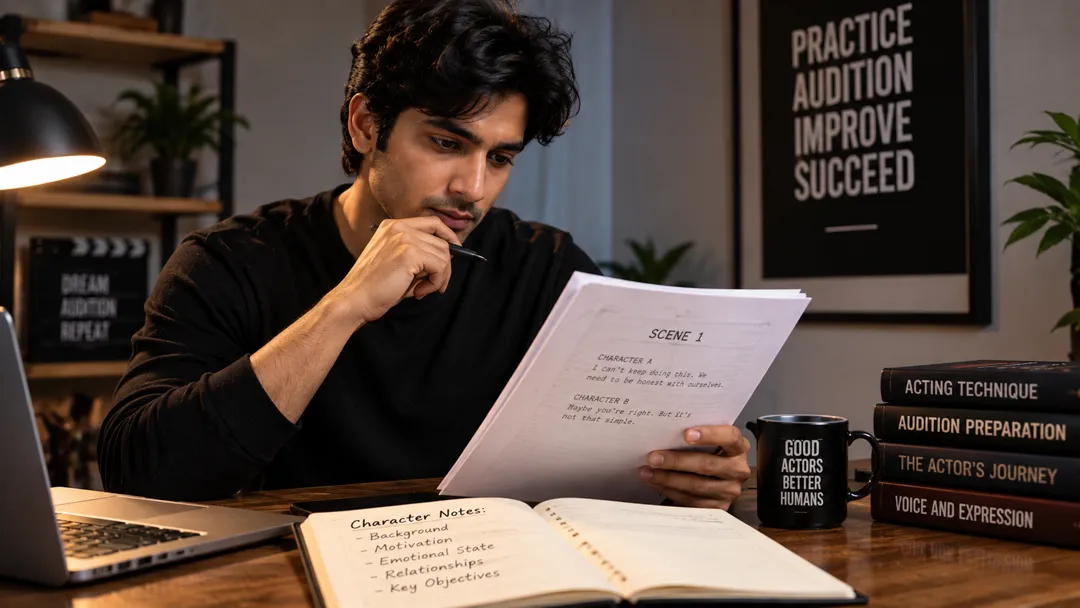
10. Focus on the Performance, Not Only the Result
An audition does not always lead to selection, and selection can depend on many factors beyond the quality of a performance.
The character may require a different age, look, voice, chemistry or interpretation.
Instead of judging every audition only by whether you were selected, use each audition as an opportunity to improve your preparation and performance.
Over time, this approach can make auditions feel less intimidating and more like part of your work as an actor.
Final Thoughts
Strong audition preparation is a combination of understanding the scene, knowing your dialogue, making clear character choices and staying comfortable in front of the camera.
You do not need to make every performance bigger. You need to make it believable.
Prepare carefully, stay present in the scene, trust your choices and give the performance your full attention.
If acting is something you genuinely want to pursue, keep learning, keep practicing and keep showing up for opportunities.
Junoon Hai Toh Jeet Hai.